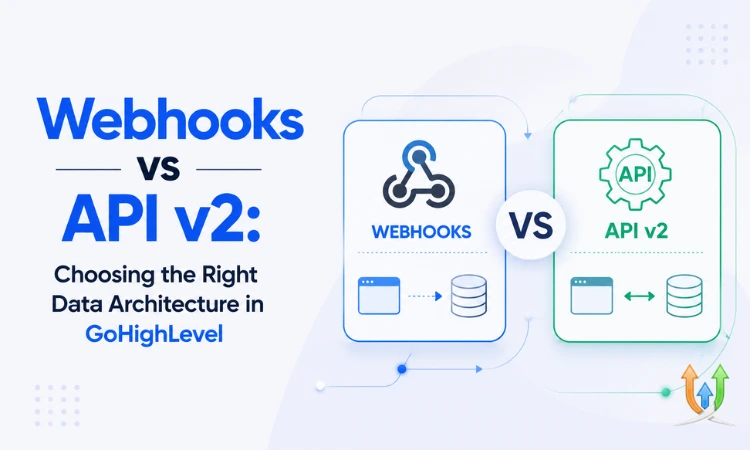
Webhooks vs API v2: Choosing the Right Data Architecture in GoHighLevel
This question comes up every time someone's building something custom on top of GoHighLevel: do I use a webhook, or do I hit the API?
The honest answer is it depends on which direction the data's moving and how fast you need it to move. People get this wrong constantly, usually by trying to force one tool to do the other tool's job. A workflow that polls the API every minute when a webhook would've fired instantly. A webhook receiver trying to pull historical data it was never built to handle.
Get the architecture wrong early and you end up rebuilding the whole integration 6 months later when it can't handle real volume. If you're not sure which way to go, it's worth talking to a GoHighLevel developer before you build anything, since the wrong choice here is expensive to undo once other systems depend on it.
Let's get into what each one actually does well.
What Webhooks Actually Do
A webhook is GoHighLevel telling you, the instant something happens. A contact gets created. A tag gets added. An appointment gets booked. GHL fires an HTTP request to a URL you control, carrying the data about that event, the moment it occurs.
No polling. No asking "did anything change yet?" every 30 seconds. The data shows up when the event happens, not a second later than it has to.
That's the entire value of a webhook: speed and event-driven design. If you're building something that needs to react the instant a lead comes in, like an instant SMS or a Slack notification to your sales team, a webhook is the right tool. Nothing else gets you that close to real time.
Where Webhooks Fall Short
Webhooks only tell you about things happening right now. They're useless for pulling historical data. You can't ask a webhook "give me every contact created in the last 90 days." It only knows about the event in front of it.
They're also fire-and-mostly-forget. If your receiving server is down for 5 minutes and a webhook fires during that window, in most setups, that event is gone unless GHL's retry logic catches it. You don't get to go back and ask for it again the way you can with an API call.
And webhooks are one-directional. They push data out of GoHighLevel. They can't pull data, update a record, or trigger an action back inside GHL. For that, you need the API.
What API v2 Actually Does
API v2 is GoHighLevel's REST API, the one you call when you need to ask for something specific or push a change into the system. Need every contact tagged "VIP" from the last 6 months? That's an API call. Need to update a custom field on 500 contacts after a data cleanup? API call. Need to create a new opportunity programmatically when something happens in an external system? API call again.
The API gives you control in both directions. Pull data out, push data in, update existing records, even build entirely custom workflows that don't exist as native GHL automations. It's the tool for anything that isn't a simple "this happened, now do that" reaction.
API v2 also supports proper authentication scopes, rate limit handling, and structured pagination for large data pulls, things a webhook was never designed to handle.
Where the API Falls Short
The API doesn't know when something happens. You have to ask it. That means if you want near-real-time updates through the API alone, you're polling, hitting the endpoint over and over to check if anything's changed. That's slow, wasteful, and burns through your rate limits fast.
Polling every minute to catch a lead that came in 47 seconds ago isn't real-time. It's just frequent. And at any real scale, that approach falls apart. You either hit rate limits or you're running infrastructure just to ask "anything new?" on a loop.
The Real Answer: Use Both, for Different Jobs
This isn't actually an either/or decision once you see what each tool is for. Webhooks handle the "something just happened, react now" layer. API v2 handles the "pull data, update records, run bulk operations" layer. Most solid integrations use both, each doing the job it's built for.
A common pattern: a webhook fires the moment a lead comes in and triggers your instant SMS response. Separately, a nightly job hits the API to sync your full contact list with an external reporting tool, since that doesn't need to happen in real time and would be wasteful to handle through dozens of individual webhook events.
This is the same logic behind something like missed call text back. The instant trigger, someone calls and doesn't reach you, fires through a webhook-driven workflow so the text goes out in seconds. There's a full walkthrough on GHL missed call text back if you want to see this pattern applied to an actual use case instead of just in theory.
How to Decide Which One You Need
A few questions that usually settle it fast:
- Do you need to know the instant something happens, or can it wait a few minutes to a few hours? Instant means webhook. Can wait means API, probably on a schedule.
- Are you pulling a large set of historical records? That's API, always. Webhooks have no concept of history.
- Are you pushing data into GoHighLevel from an outside system? API. Webhooks are one-way, out of GHL only.
- Is this a one-off sync or an ongoing real-time need? One-off leans API. Ongoing and reactive leans webhook.
- Do you need to update or create records based on logic that runs outside GHL? API, since webhooks can't write back.
If you land on "both," that's not a wrong answer. It's usually the right one.
Test This in a Sandbox Before It Touches Live Data
Whichever direction you go, don't point a new webhook or a fresh batch of API calls at a live sub-account on day one. Webhook payloads change shape more often than people expect, and a malformed payload hitting your production server can break downstream systems you didn't think were connected to this at all.
Build and test the integration in an isolated sub-account first. Trigger the webhook with real test contacts. Run the API calls against dummy data and check the response structure matches what you're expecting before any real lead data flows through it. The setup for this kind of testing environment is covered in the piece on GoHighLevel sandbox for snapshots, and the same sandbox principles apply just as much to webhook and API testing as they do to snapshot deployment.
Rate Limits Will Bite You If You're Not Watching
API v2 has rate limits, and they're easy to hit if you're running bulk syncs without thinking about batching. Pulling 10,000 contacts in a tight loop without pacing your requests is a fast way to get throttled mid-sync, leaving you with a half-finished data pull and no clean way to tell where it stopped.
Build in batching and respect the rate limit headers GHL sends back. If you're syncing large volumes regularly, this isn't optional. It's the difference between an integration that runs quietly in the background and one that fails randomly once a week for reasons nobody can immediately explain.
Get the Foundation Right Before You Build On Top of It
This decision matters more early on than people expect, because whatever you build on top of webhooks or the API gets harder to change the more systems start depending on it. If you're setting up GoHighLevel for the first time and planning custom integrations down the line, it's worth getting the sub-account structure and data flow planned out from day one. The onboarding checklist covers the sequencing that prevents you from bolting integrations onto a structure that wasn't built to support them.
And if you're weighing whether to build this integration yourself or bring someone in, that's a fair question to ask honestly before you start. Webhook and API architecture isn't beginner territory the way building a simple automation is. The comparison in GHL DIY vs hiring a pro lays out where the line usually sits, and integration work like this tends to land pretty clearly on one side of it.
Neither webhooks nor API v2 is the better tool in some general sense. They're built for different jobs, and a setup that uses each one where it actually fits will outlast and outperform anything built by forcing one to cover for the other.
Author Bio
Lead GHL Developer
Harry's been deep in the GoHighLevel world for 7+ years, tackling everything from tricky automations to custom API integrations that make clients' systems hum. If there's a way to tighten a process, he's obsessed with finding it. When he's not coding, he's probably testing new GHL updates way too late at night.